
Unknown Residue on Cast Iron: Pause Before You Restore or Cook
On this page
Quick answer
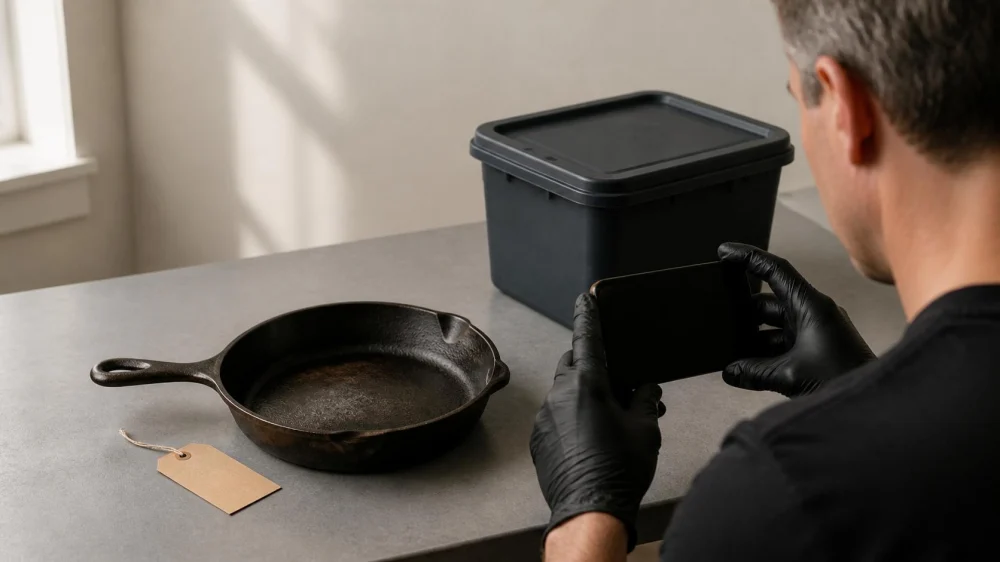
If a used cast iron pan has unknown paint, metallic dust, wax, chemical odor, sticky coating, or workshop residue, do not cook in it or heat it to “burn off” the material. Isolate it from food tools, photograph the pan, ask about its history, identify the original product and finish, and use qualified testing or professional advice when contamination is plausible. When safety cannot be established, keep it decorative or discard it appropriately.
Appearance alone cannot prove that a black or colored layer is ordinary seasoning. Restoration removes corrosion and old food residue; it does not automatically make unknown industrial or decorative use safe for food.
Miracle Method of Tempe / miracle method of tempe
1635 W University Dr UNIT 126, Tempe, AZ 85281, USA
Separate evidence from guesses
Without scraping or sanding, note the residue’s color, location, texture, odor, and whether it flakes, smears, powders, or covers maker marks. Photograph the whole object and close details beside a ruler. Record where it came from and how it was stored.
Ordinary seasoning is generally a thin, bonded cooking-oil layer, but old cookware may also carry house paint, stove polish, wax, adhesive, plating, enamel, soot, machine oil, pest treatment, or material from a display. None can be identified reliably by color alone. A home swab result may be limited by the tested element, surface access, technique, and false results; do not treat one negative screen as proof of food-contact safety.

America Refinishing Pros / america refinishing pros
9510 SW 137th Ave, Miami, FL 33186, USA
Trace the pan’s history
- Ask the seller or donor whether the piece was used for food, decoration, plants, candles, crafts, automotive work, melting material, or pest control.
- Find maker marks, size numbers, mold features, and product photographs without grinding the surface.
- Determine whether the item was manufactured as cookware, an appliance part, a decorative reproduction, or another casting.
- Look for enamel, plating, repair welds, drilled holes, added paint, or non-original hardware.
- Write down any claimed cleaning or restoration method, including lye, electrolysis, abrasive blasting, solvents, or coatings.
A clear chain of ordinary kitchen use is useful context, not a laboratory result. A vague “vintage” label or resemblance to a skillet does not establish intended use.
Choose a safe path
If the pan is a known bare cast iron cookware model with a credible food-use history and only normal grease, carbon, or rust, follow conservative manufacturer-compatible restoration. If a specific contaminant or coating is suspected, contact a local public health program, qualified laboratory, manufacturer, or restoration professional and ask what sample and method can answer the question.
If unknown residue penetrates cracks or deep pits, if professional testing is impractical, or if the item was used for chemicals or melting non-food materials, do not use it for cooking. Decorative display should still prevent children from touching peeling material. Follow local household hazardous-waste or disposal guidance when lead paint, chemicals, or metal contamination is suspected.
What to avoid
- Do not heat an unknown coating indoors; heat can create fumes or spread contamination.
- Do not sand, grind, wire-wheel, or blast it before assessing dust hazards.
- Do not taste, smell closely, or use food acids as an informal “test.”
- Do not use a kitchen oven, sink, dishwasher, utensils, or towels for a questionable item.
- Do not mix bleach, acids, lye, solvents, or rust removers.
- Do not sell or gift it as food-safe without evidence supporting that claim.
Assessment checklist
- Item isolated from food-preparation areas
- Residue and maker marks photographed intact
- Original product type researched
- Prior use and restoration history requested
- Enamel, plating, repairs, cracks, and pits recorded
- Specific contamination question defined
- Qualified testing or professional advice chosen if justified
- Food use withheld until safety is established
Limitations
This article cannot identify a coating or declare cookware safe from a photograph. Laboratory methods answer specific questions and may require representative sampling. Requirements for disposal and professional testing vary locally. For suspected exposure or symptoms, contact a health care professional or poison control service.
FAQ
Can I burn everything off in a self-cleaning oven?
No. Unknown material may release hazardous fumes, contaminate the oven, damage cookware, or create a fire risk.
Is black residue always seasoning?
No. Color is not enough to identify food residue, seasoning, paint, polish, or another coating.
Will a lead swab prove the pan is safe?
A screen may address one hazard under specific conditions. It does not identify every contaminant or prove intended food use.
Can electrolysis make it food-safe?
Electrolysis can remove rust in suitable restoration work; it does not establish that unknown prior contamination is gone.
Is decorative use always safe?
Not if material is flaking or accessible to children or pets. Isolate, contain, or dispose of it according to the suspected hazard.
Evidence notes
The U.S. Food and Drug Administration explains that cookware is a food-contact surface and that lead is not authorized as a food or color additive in foodware. The FDA’s lead in food and foodwares guidance also illustrates why composition and leaching—not appearance—matter. That source does not say every old cast iron pan contains lead; it supports avoiding unsupported safety claims and using an appropriate method for a defined concern.
Conclusion
When residue is unknown, restraint is part of restoration. Preserve the evidence, trace intended use, avoid heat and dust, ask a testable question, and reserve the pan for food only when its material and history support that decision.



 Carolinas Custom Kitchen & Bath Center4.0 (27 reviews)
 Madrid's Contracting5.0 (22 reviews)
 Capital Renovation & Construction Inc.5.0 (20 reviews)
 Gateway Porcelain Refinishing5.0 (1 reviews)
 SK Remodeling and Decorating Inc.5.0 (38 reviews)
 Crown Custom Cabinetry Inc4.0 (4 reviews)
 How to Refurbish a Cast Iron Skillet at Home: A Complete Guide
 Best Products for Cast Iron Restoration Service: Top Tools and Products
 Simple At-Home Techniques for Cast Iron Restoration | Restore Your Cookware
 How to Restore Cast Iron at Home | A Complete Guide for Beginners
 How Long Does Cast Iron Skillet Refinishing Take? Realistic Timeline for Restoration
 What to Avoid When Attempting Cast Iron Refinishing: Common Mistakes to Watch Out For