
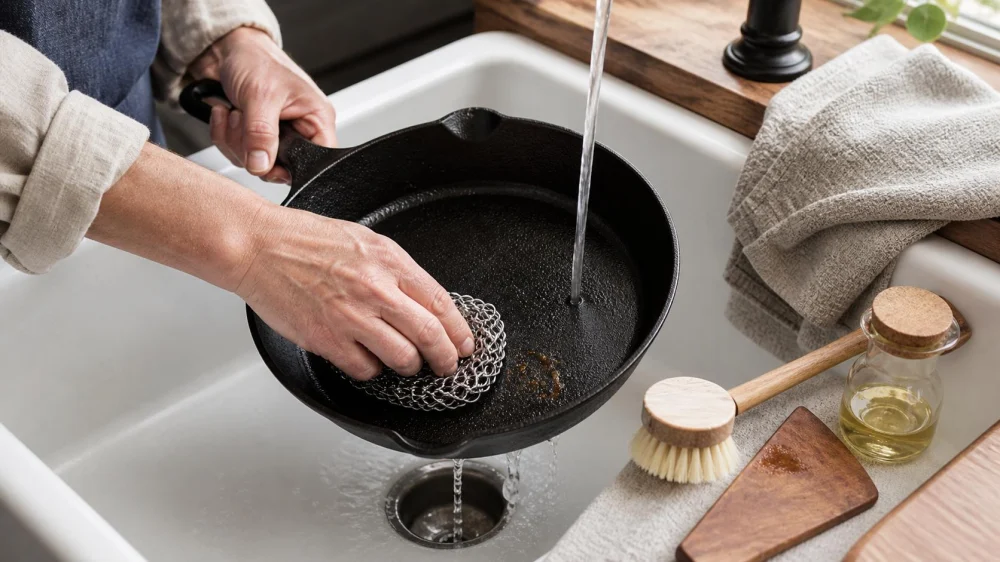
Cast Iron Chainmail Scrubber: Clean Without Damaging Seasoning
On this page
- Know what chainmail is for
- Use it only on compatible surfaces
- Let the pan cool safely
- Start with water and a simple wash
- Use light, controlled pressure
- Focus on stuck food, not dark color
- Rinse, dry, and check the surface
- Refresh seasoning only when needed
- Clean and store the scrubber
- Choose another tool when appropriate
- Chainmail scrubber checklist
A stainless-steel chainmail scrubber can lift stuck food from seasoned bare cast iron without the sharp scraping edge of a blade. Used gently, its rounded rings move across high spots while much of the seasoning stays in place. Used aggressively—or on the wrong surface—it can scratch, expose bare metal, or damage enamel.
The scrubber is one tool in a simple cleaning routine, not a way to polish a skillet until every dark mark disappears. Let the pan cool, soften residue with warm water, use controlled pressure, and stop when the food releases. Then rinse, dry promptly, and inspect the surface before deciding whether any seasoning touch-up is needed.

Miracle Method Surface Refinishing / miracle bathtub refinishing
Santa RosaSonoma CountyCalifornia
3200 Dutton Ave Suite #325, Santa Rosa, CA 95407, USA
Know what chainmail is for
Chainmail works best on localized cooked-on food, caramelized residue, and rough bits that a normal brush or sponge does not remove easily. It can conform to curves and does not hold as much debris as some abrasive pads.
It is not intended to remove deep rust, strip an entire failed seasoning layer, grind down casting texture, or repair pitting. Those conditions require a separate assessment and an appropriate restoration method. Repeated hard scrubbing can turn a routine wash into unnecessary refinishing.
Use it only on compatible surfaces
Use chainmail on sound bare cast iron when the manufacturer or experienced care guidance supports it. Do not assume that a black interior is bare iron. Some enameled cookware uses dark matte enamel that can resemble seasoning.
A metal scrubber can scratch or chip enamel, nonstick coatings, polished finishes, and other cookware surfaces. Check the product instructions for both the pan and scrubber. When uncertain, use a softer tool and ask the manufacturer.
Let the pan cool safely
Move the skillet off heat using dry, secure protection and place it on a heat-safe surface. Cast iron handles stay hot long after cooking. Let the pan cool enough for safe washing, but do not leave food residue for days.
Never pour cold water into very hot cast iron. Thermal shock can warp or crack the pan and can create steam burns or splatter. Do not hold a hot skillet under the faucet while gripping it with a wet towel or loose cover.
Start with water and a simple wash
Remove loose food with a wooden or suitable utensil, then wash the cooled pan with warm water. A small amount of ordinary dish soap is generally compatible with sound modern seasoning when the cookware guidance permits it. Old advice about soap often referred to harsher historical products.
Let warm water soften the stuck area briefly rather than soaking the pan for a long period. Standing water can reach exposed iron and encourage rust. Use a regular brush or sponge first; bring in chainmail only for residue that remains.
Use light, controlled pressure
Hold the pan securely in the sink or on a stable surface. Move the scrubber in small circles or short strokes with light pressure. Support the handle so the skillet does not slide, and keep fingers away from any chipped rim or sharp casting defect.
Check progress every few strokes. More pressure is not necessarily faster; it can remove weak seasoning around the food and leave a bright patch. If the residue does not change, add warm water and time or switch to a suitable nonmetal scraper rather than bearing down.
Focus on stuck food, not dark color
Seasoning ranges from amber to deep black and can be uneven, especially on a newer pan. Dark color alone is not dirt. Target material that feels raised, sticky, flaky, or clearly different from the surrounding surface.
A thin, smooth, bonded layer belongs on bare cast iron. Trying to make the surface uniformly gray or mirror-bright removes protection. If black residue transfers heavily to a cloth or food, assess whether the seasoning is burned, loose, or contaminated instead of scrubbing indefinitely.
Rinse, dry, and check the surface
Rinse away all food and loosened material. Feel the cooled surface with clean fingers for remaining raised spots, taking care around damage. Repeat only where needed. Wash again after chainmail use so no small debris remains.
Dry the skillet immediately with a clean towel, then use gentle stovetop heat only if you can monitor it continuously and the pan is sound. Turn off the heat as soon as moisture is gone. Never leave an empty pan heating unattended.
Refresh seasoning only when needed
If the surface remains dark, dry, and water-resistant, routine cleaning may be enough. If scrubbing exposes a small dull gray area, apply an extremely thin film of suitable cooking oil to the warm dry pan and wipe away the visible excess.
For larger bare areas, rust, sticky layers, or widespread flaking, follow a controlled seasoning or restoration process rather than adding thick oil. Excess oil creates tacky, uneven layers. A seasoned pan should not feel greasy in storage.
Clean and store the scrubber
Rinse the chainmail thoroughly, working food from between the rings. Wash it according to its product instructions and inspect for broken, opened, bent, or sharp links. A damaged link can scratch cookware or skin and should be retired.
Dry the scrubber completely and store it where it will not remain in contact with a damp pan. Do not leave it inside cast iron, where trapped moisture and dissimilar metals can create marks or corrosion. Keep it away from children and mixed utensil drawers where a sharp damaged link could be missed.
Choose another tool when appropriate
Use a soft brush or sponge for everyday residue, a wooden or manufacturer-approved scraper for a flat stuck area, and coarse salt only when compatible guidance recommends it. The gentlest effective method preserves seasoning and requires less follow-up.
For cracks, severe pitting, unknown coatings, heavy rust, lead concerns, fire damage, or enamel chips, stop and assess the pan rather than choosing a stronger scrubber. An experienced restorer or manufacturer can help determine whether restoration or retirement is appropriate.
Chainmail scrubber checklist
- Confirm the pan is sound, bare, seasoned cast iron.
- Let it cool safely and avoid thermal shock.
- Start with warm water, soap if appropriate, and a soft tool.
- Use chainmail only on residue that remains stuck.
- Apply light pressure in short, controlled strokes.
- Clean raised food instead of chasing dark seasoning.
- Rinse thoroughly and dry the skillet immediately.
- Use only a very thin oil film when needed.
- Wash, inspect, dry, and store the scrubber separately.
- Choose expert assessment for damage or unknown coatings.
A chainmail scrubber is effective because it can be precise. Soften the food, work the stubborn spot gently, and stop as soon as the surface is clean. When the tool serves the cleaning job instead of becoming a restoration project of its own, the skillet keeps more of the seasoning that makes everyday cast iron cooking easier.





 Krumsee Construction5.0 (2 reviews)
 Honea Construction & Remodeling5.0 (124 reviews)
 Resurface America5.0 (6 reviews)
 Set Clean Bathtub Refinishing and Paiting4.0 (54 reviews)
 Brighton Bathroom5.0 (36 reviews)
 Elegant Kitchen and Bath5.0 (259 reviews)
 How to Refurbish a Cast Iron Skillet at Home: A Complete Guide
 Best Products for Cast Iron Restoration Service: Top Tools and Products
 Simple At-Home Techniques for Cast Iron Restoration | Restore Your Cookware
 How to Restore Cast Iron at Home | A Complete Guide for Beginners
 How Long Does Cast Iron Skillet Refinishing Take? Realistic Timeline for Restoration
 What to Avoid When Attempting Cast Iron Refinishing: Common Mistakes to Watch Out For